Charolais and Limousin are among the most famous French beef breeds, and their genetics are now used far beyond Europe.
Both breeds are characterized by good carcass meatiness and high production potential, but there are differences in body mass, muscle development, ease of calving, and how well they fit into different farming systems. Charleol is generally associated with a larger body frame and high gain, while Limousin is known for its favorable muscle-to-bone ratio, high carcass yield, and its ability to adapt to pasture-based production.
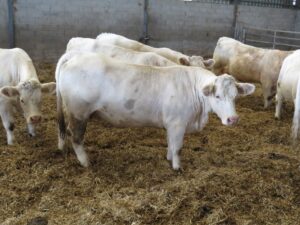
Charolais originates from Burgundy, and adult bulls typically reach a weight of 1,100 to 1,400 kilograms, while cows usually weigh from 700 to 900 kilograms. Limousin originates from the Limousin region in central France. Adult bulls typically weigh from 1,000 to 1,300 kilograms, and cows from 600 to 800 kilograms. These values are indicative, as body weight depends on the genetic line, age, diet, and rearing conditions. Charolais has the advantage when the goal is the production of larger fattening animals and greater absolute carcass weight, while Limousin often achieves a high proportion of saleable meat due to its pronounced musculature and relatively fine bones.
 One of the most important differences relates to reproductive traits. In Charolais, due to a higher potential for birth weight in calves, sires must be carefully selected, especially for inseminating heifers. Limousin is known for its relatively favorable calving ease, although it is not guaranteed even with this breed. Modern breeding programs therefore evaluate bulls not only on body conformation and growth, but also on genetic indicators of birth weight, calving ease, maternal traits, and offspring quality. In practice, the choice of a specific sire can be more important than the average differences between two breeds.
During a visit to the Sommet de l’Élevage international fair in 2026 in Clermont-Ferrand, journalists from AGROPRESS visited the Bonant farm in the town of Romagnat, at an altitude of approximately 650 meters above sea level. This organic farm raises 75 Limousin mother cows, and production is organized on 180 hectares of land, 175 of which are forage areas. A full 95 percent of these areas are natural pastures. During part of the year, the cattle share the pastures with Comtois horses, and the farm relies on its own forage and the limited use of concentrates. This example shows how the Limousin can be successfully integrated into a more extensive production system, where controlling feed costs is just as important as gain.
 The farmer at Bonant particularly emphasized the importance of preserving old natural grasslands. “I have pastures that are 45 years old, and it wouldn’t cross my mind to plow them over. I’m not sure I could create something this good again,” he explained during the tour. On some paddocks, legumes make up 40 to 45 percent of the plant cover, which contributes to the nutritional value of the forage. According to data presented at the farm, a five-year-old Limousin cow, after a six-month finishing phase, yielded a carcass weighing 435 kilograms. The diet was based mostly on grass, with approximately 2.5 kilograms of rolled barley per day and an addition of dehydrated alfalfa. This is a specific example from the farm, not the breed’s average production result.
The economic value of the Limousin was particularly highlighted at the breeding stock auction held on October 7, 2026, as part of the Sommet de l’Élevage. The bull Actif, from the EARL Hérisson farm, was sold to a buyer from the Netherlands for €28,100, while the bull Amidon reached €26,100 and ended up with a breeder in Portugal. Gilles Leche, a representative of the Interlim organization, highlighted Actif’s harmonious body structure, fine bones, body length, and pelvic width when presenting him. For buyers, in addition to the animal’s appearance, its pedigree and expected genetic potential were crucial. These prices do not represent the usual value of fattening cattle, but are the result of bidding for selected breeding stock.
When choosing between Charolais and Limousin, feeding conditions, available space, and the method of sale are also important. Charolais can be particularly interesting in intensive fattening systems, where its potential for high daily gain and greater final carcass weight is utilized. Limousin is also successfully used in grazing systems, especially when the producer aims to achieve a good yield and control costs. However, both breeds can be raised both intensively and extensively, so their profitability cannot be determined without data on feed costs, reproductive performance, health costs, and the market value of calves or feeder cattle.
 In France, both breeds are also used for crossbreeding with other cattle populations. Charolais is often chosen when the goal is to increase the offspring’s growth and carcass mass potential, while Limousin is used to improve meatiness, yield, and other production traits. It is necessary to take into account the size and age of the cows, as choosing an unsuitable bull can increase the risk of difficult calvings. The best results are achieved when crossing is planned according to specific genetic indicators, and not just based on breed affiliation.
Therefore, a comparison of Charolais and Limousin does not have a clear-cut winner. Charleol has a pronounced potential for producing large feeder calves, while Limousin offers a good combination of meatiness, yield, and reproductive traits. For the producer, the most important factor is how many kilograms of marketable meat are obtained in relation to production costs, while maintaining the fertility and longevity of the breeding stock. This is precisely why French breeders are paying increasing attention to selection indexes, pedigree, and progeny performance, instead of basing selection solely on the animal’s appearance.